Key Takeaways
Equine lameness has many causes, from hoof to joint. Learn how to read lameness and when a vet is needed. Free WhatsApp consultation.
Equine Lameness: Reading It Before It Becomes a Big Problem
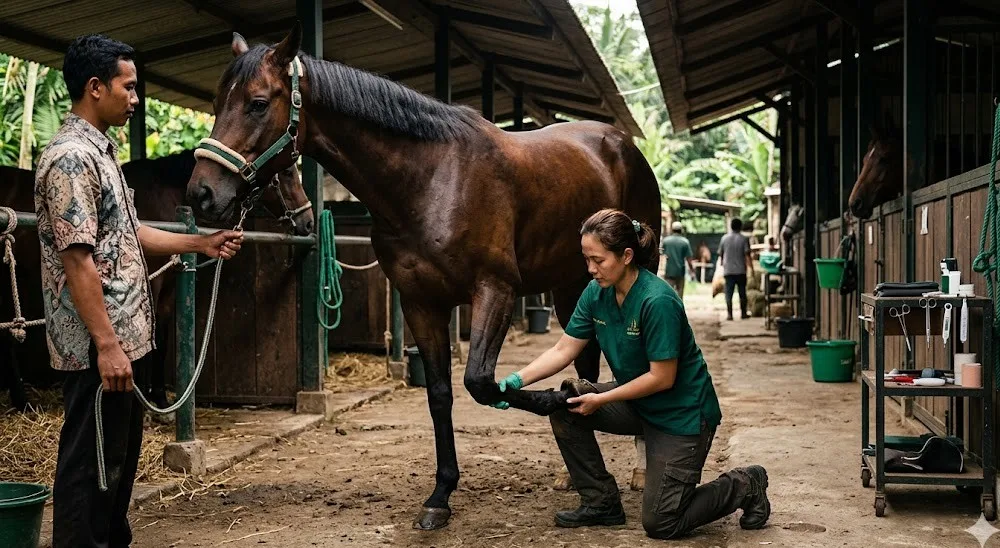
Lameness is one of the most common complaints in horses. For an animal whose entire life rests on its four legs, any disturbance to its stride is no small matter. What makes lameness challenging is that the cause can come from anywhere, from the hoof, muscles, tendons, joints, to the back, and the severity varies widely.
I wrote this to help owners and grooms read lameness early. Not to diagnose it yourself, but so you know what to watch for and when to ask a vet to assess it.
Why Lameness Is Hard to Read Alone
Don't Wait Until It's Too Late!
Horses are good at compensating. When one leg feels uncomfortable, it shifts weight to another leg and changes how it moves to reduce pain. This compensation sometimes makes mild lameness invisible in the stable, only appearing when the horse works. Conversely, some lameness is more obvious when the horse first gets up and eases after warming up.
So lameness reads most honestly when the horse moves. Watching it walk and trot on a flat surface, in a straight line and in circles, often gives early clues about which leg has the problem.
Signs You Need to Watch For
The following can be clues that something is wrong with your horse's stride.
The horse's head nodding more strongly to one side while walking is often a sign of front-leg lameness. A stride that feels short or hesitant on one leg, a horse reluctant to fully bear weight, or an uneven rhythm of steps also deserve attention. In the hind legs, change often shows in asymmetric hip movement.
Besides the gait, also watch for unusual heat in one leg, swelling, or a horse pulling its leg away when a certain area is touched. An odd standing posture, for example a horse constantly resting one leg, can also mean something.
When This Is an Emergency
Most lameness can be evaluated calmly, but there are situations that should not be delayed.
A horse that suddenly becomes very lame and barely bears weight at all needs immediate assessment, because severe acute lameness can signal a serious problem. A very hot leg, sudden swelling, or an accompanying open wound also need prompt attention. Likewise if the horse looks in great pain, restless, or refuses to move at all.
Conversely, mild lameness that has just appeared can be rested and watched first, then consulted. The key is not to force a lame horse to keep working, because that can worsen the situation.
Ask the vet by your horse type
Pick your horse and the chat opens pre-filled so our team knows exactly which type it is.
What You Can Do While Waiting
Rest the horse and stop training or work. Check the hoof carefully, sometimes the cause of lameness is as simple as a stone or a stuck object. Note when the lameness started, in which leg, and whether it improves or worsens after rest. Avoid giving pain relief without guidance, because as in other cases, it can mask severity and complicate assessment.
Why a Vet's Assessment Matters
Because the causes of lameness are so varied, guessing on your own is often wrong and can sometimes turn a mild problem into a drawn-out one. A systematic assessment helps confirm where the pain comes from before deciding on a step. For certain examinations requiring advanced imaging, the honest step is to refer to a facility equipped for it.
Free Consultation via WhatsApp
If your horse's stride feels different and leaves you unsure, do not force it to work. Contact us over WhatsApp for a free consultation, tell us what you observe, include a video of the horse walking if you have one, and we assess the next step together.
See also Equine Vet: Ambulatory Service to Stables and Colic in Horses: Why It Is an Emergency.
Frequently Asked Questions
How do I know which leg is lame?
Should a lame horse always be fully rested?
Can I give pain relief while waiting?
When is lameness an emergency?
Can I consult over WhatsApp first before a visit?
Medically Reviewed by
Birawa Vet Medical Team
This article has been verified by our medical team to ensure veterinary information accuracy.
The information in this article is for general educational purposes only and is not a substitute for direct consultation with a veterinarian.
Every pet has unique conditions. Do not hesitate to seek professional help if your pet is sick.
Share Article
Senior Pets Need Special Care
Not sure if your pet's symptoms are normal or urgent? Tell our vet — we help evaluate without requiring immediate booking.
Read Next
View All
A Canary That Stops Singing: When It Is Medical, Not Just Moulting
A canary that stops singing is not always moulting. Learn when the silence is a natural phase and when it signals a health problem that needs a vet. Free WhatsApp consultation.

Sulcata Tortoise Won't Eat: Causes and When to See a Vet
Your sulcata on a food strike? Often it is not about taste but temperature, light, and enclosure care. Learn the causes and when to see an exotic vet. Free WhatsApp consultation.
Hedgehog Refusing Food or Bloating: When to See a Vet
Hedgehog refusing to eat or its belly looks bloated? Learn the warning signs, how it differs from a hibernation attempt, and when to see an exotic vet. Free WhatsApp consultation.