Key Takeaways
Hedgehog refusing to eat or its belly looks bloated? Learn the warning signs, how it differs from a hibernation attempt, and when to see an exotic vet. Free WhatsApp consultation.
Hedgehog Refusing Food or Bloating: When to See a Vet
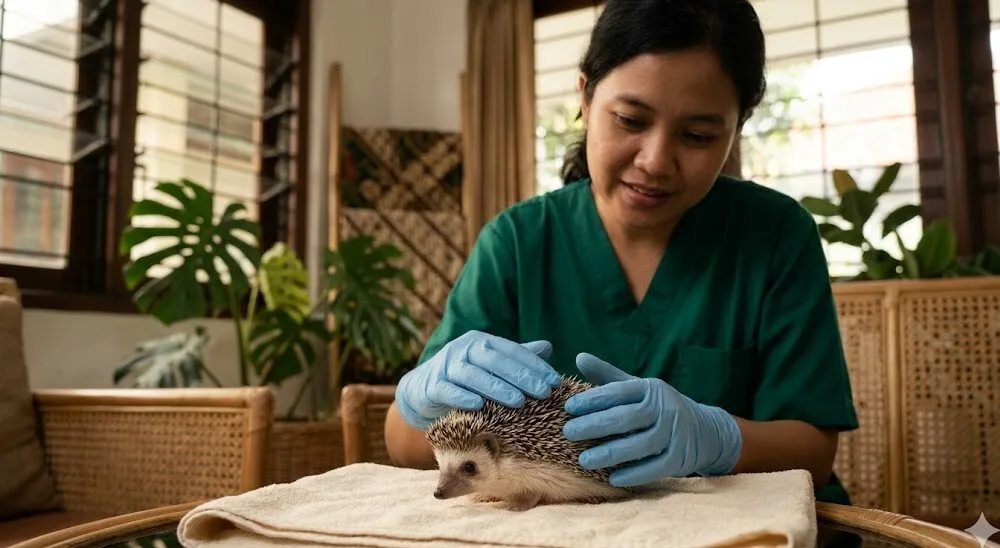
Of all the concerns hedgehog owners bring to me, the two most common are "why won't it eat" and "its belly looks swollen". Both sound minor, but in an animal this small, both can be early signals of a serious problem. I want to explain it calmly, so you can judge for yourself when something can still be watched at home and when it is time to ask for help.
Knowing a healthy hedgehog first
Don't Wait Until It's Too Late!
Before talking about illness, it helps to agree first on what a healthy hedgehog looks like. It is active at night (hedgehogs are nocturnal), its appetite is stable, its movements are brisk, and its droppings are firm. It does like to curl up when it feels threatened, and that is normal. What is not normal is when it becomes lethargic, rarely moves, or its eating pattern changes drastically. Because, like many other exotic pets, a hedgehog is skilled at hiding its pain. By the time you notice something is wrong, its body has often been struggling for some time already.
When a hedgehog refuses food
A hedgehog refusing to eat should not be dismissed with "it will get hungry eventually". Its small body has limited energy reserves, so a prolonged fast quickly leaves it weak and dehydrated.
The causes can vary, from mild to serious. Stress from a cage move or a new environment can cause a temporary food strike. An environment that is too cold also has a big effect. This is where one important, often misunderstood point arises. In cold temperatures, a hedgehog can attempt to hibernate, and this hibernation attempt is dangerous for a pet hedgehog because its body is not built to get through it. The signs are a cold-feeling body, a lower belly colder than usual, and very sluggish, sometimes unsteady movement. This is different from simply being sleepy; it needs prompt handling and gradual, careful rewarming. As a guide, hedgehogs are generally comfortable at room temperatures around 24 to 30 degrees Celsius, and should be given extra warmth if the room drops below around 18 degrees Celsius.
Other, more medical causes include dental and mouth problems that make eating painful, digestive disorders, infection, or other illness not yet visible from the outside. So a food strike should not be viewed only as a matter of taste.
When a hedgehog's belly looks bloated
A belly that grows large or feels hard also deserves serious attention. In an animal this small, bloating can relate to gas buildup, digestive disorders, constipation, or a mass or fluid in the abdomen. I deliberately avoid guessing a single cause, because a swollen belly is a symptom, not a diagnosis. What you can observe at home is whether it still passes droppings, whether the droppings have changed (diarrhoea or none at all), whether it seems to be in pain when its belly is touched, and whether its appetite has dropped too. A bloated belly combined with not eating and lethargy is the mix that makes me want to examine it right away.
Ask the vet by your pet's species
Pick your animal and the chat opens pre-filled so our team knows exactly which species it is.
Signs that make me ask you not to wait
Some conditions should not be observed at home for too long:
- Not eating for more than 12 to 24 hours.
- A cold-feeling body and very sluggish movement (possible hibernation attempt).
- A swollen or hard belly accompanied by lethargy or pain.
- Diarrhoea, or conversely no droppings at all.
- Heavy, noisy, or gasping breathing.
- Refusing to move, just curled up still, out of character.
I always say, for an animal as small as a hedgehog, even a little doubt is reason enough to ask. No question is too small.
What you can do while contacting a vet
While reaching out to me, make sure the cage is warm and free of direct draughts. Provide easily reachable drinking water. Offer the food it usually likes in small portions. Avoid force-feeding or giving human medicine, because in a body this small, the wrong dose is itself dangerous. Note since when the symptoms appeared and any changes you have seen, because that information greatly helps me assess its condition.
Better to ask early
A hedgehog does not give much time once its condition declines. If it goes on a food strike or its belly looks swollen and you feel something is wrong, just tell me first. The initial WhatsApp consultation is free, and from there we can judge together whether it is enough to observe, needs a home examination, or needs immediate care.
Want to read more per species? See Exotic Pet Vet Home Visit Jabodetabek, a sick hamster, a sick sugar glider, and a sulcata tortoise that won't eat.
Frequently Asked Questions
My hedgehog has not eaten all day, is that dangerous?
Why does my hedgehog's belly look bloated?
What is the difference between a sleepy hedgehog and one attempting hibernation?
Can I give human medicine to a sick hedgehog?
Can a vet come to my home to examine a hedgehog?
Medically Reviewed by
Birawa Vet Medical Team
This article has been verified by our medical team to ensure veterinary information accuracy.
The information in this article is for general educational purposes only and is not a substitute for direct consultation with a veterinarian.
Every pet has unique conditions. Do not hesitate to seek professional help if your pet is sick.
Share Article
Need an Exotic Pet Vet?
Our vet understands exotic pet anatomy and medical needs — coming directly to your home.
Read Next
View All
A Canary That Stops Singing: When It Is Medical, Not Just Moulting
A canary that stops singing is not always moulting. Learn when the silence is a natural phase and when it signals a health problem that needs a vet. Free WhatsApp consultation.

Sulcata Tortoise Won't Eat: Causes and When to See a Vet
Your sulcata on a food strike? Often it is not about taste but temperature, light, and enclosure care. Learn the causes and when to see an exotic vet. Free WhatsApp consultation.

A Sick or Crashing Lovebird: Signs You Must Not Ignore
A crashing lovebird is often noticed too late because birds hide illness so well. Learn the early signs and when to see a vet right away. Free WhatsApp consultation.